


At six in the morning, my sister calls. Our ninety-year-old father has been taken from his skilled nursing facility to the emergency room. Before the nature of the emergency is clear, the day is already being rearranged: appointments moved, emails sent, Slack messages answered from the car.
The trips to the ER over the past two years have run well past counting. Familiarity is a strange sort of credential, and by now the vocabulary comes easily enough that a stranger might mistake me for staff. What it does not supply is an answer to the question riding along with every one of these calls. How serious is it this time?
Over the next seven days, two sets of conversations run in parallel. One belongs to the business, which does not pause for any of this. The other belongs to nurses, doctors, my father, and my siblings. Everyone needs an answer to a simple question, and most of the questions are reasonable. The difficulty is that they arrive together, and answering one usually requires finding someone who can answer the other. Being the person at the hospital makes me responsible for the update. That doesn't mean I have one.
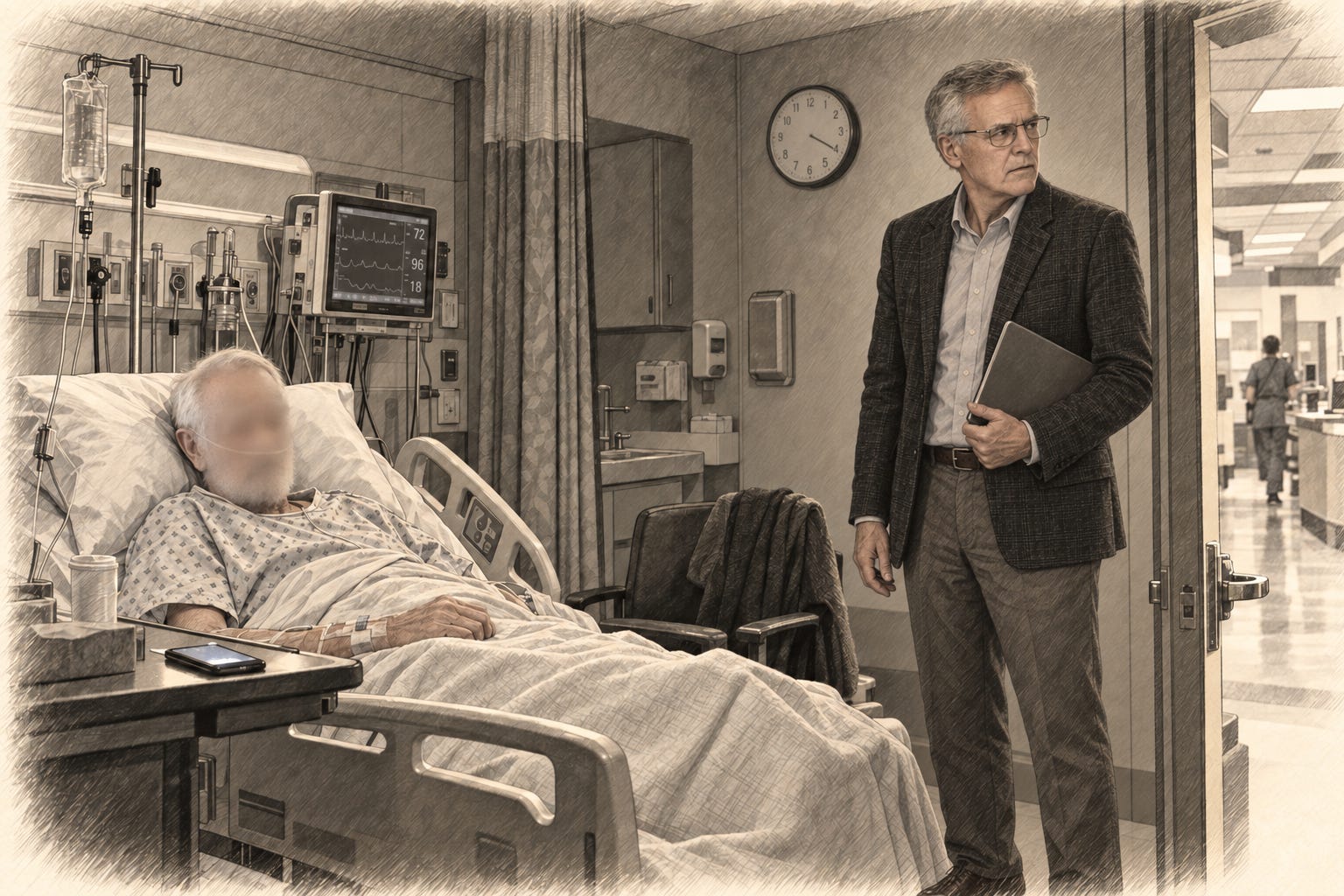
For a long stretch, there is only waiting. The laptop opens, work gets done, and forty-five minutes later, a nurse needs to be tracked down. The phone lights up with nothing new to report.
Then the blood work comes back. His white count is roughly three times what it should be, which is what the body does when an infection is winning. His hemoglobin is 4. A healthy man runs somewhere between 13 and 17, and most hospitals reach for a transfusion below 7. At 4, a ninety-year-old heart is being asked to move oxygen that is not there. He is fighting an infection, he is bleeding somewhere, and a long year of treatment has left him without much in reserve.
Underneath the questions about numbers sit the only two that matter. Is this it? Will he be okay? The laptop is still open. So are the messages. The people sending them have their own days to get through, and almost none of them can see mine.
Something is different this time, and noticing it takes most of the morning. Earlier in my caregiving, I spent a lot of energy on what the responsibility was costing me. Did anyone understand the appointments being moved, the work postponed, the sacrifice involved? Those costs were real. So was the resentment. It was entirely possible to do exactly what Dad needed while conducting an argument in my head about how much I had been asked to carry, and that argument consumed attention that could have gone to better places. It never once produced an answer that satisfied me.
Care is required here because someone reading this may be caring for a parent, a spouse, or a child and may already feel guilty for being exhausted. Caregiving demands sustained attention, patience, and practical competence under conditions that make all three hard to summon, and love does not make any of it lighter. A person can be devoted to someone and still wish desperately for one afternoon when nobody needs anything. Naming my own victim mentality is not a diagnosis to hand to anyone else. Another caregiver may need help, or sleep, or someone to finally say out loud how much they are carrying.
This morning, the arithmetic runs differently. Being Dad’s caregiver is simply the assignment, and there is agency in how it gets met. Questions can be asked. Siblings can be kept informed. A frightened old man can be made to feel less alone in a room full of strangers. An inventory of what is going right is available too: he is in the right place, someone who loves him is beside the bed, and none of this is unfamiliar territory anymore. Gratitude gives attention somewhere useful to go, and the uncertainty, while it does not shrink, stops occupying every inch of the room.
That change had taken work, all of it done well before the phone rang. Months of closer attention to sleep, food, and movement. Guitar practice, which means staying with a passage the hands cannot yet play. Journaling offers the chance to examine a thought rather than merely having it. Service work provides repeated opportunities to be useful while others struggle.
How much any single practice contributed to that particular morning is impossible to say. What can be said is that the work was deliberate, and the difference showed up the moment pressure arrived. There was more room to consider what the situation needed before reacting to how it felt. Decades of business experience were still there, but so was a little more patience with the interruption of a plan. The old instruction about leading yourself before leading others turned out to be unexpectedly practical. My father needed the person I had been preparing to become.
As the day unfolds, the people caring for him become their own study. Attention in the ER is inconsistent. Some staff are entirely present. Others are somewhere else, and asking them a question feels like interrupting someone who has not yet returned to the room. A shift change arrives with answers still outstanding. Tenacity is called for, and so is kindness, because Dad needs an advocate and the staff’s help is not optional. An emergency department holds demands that no family member standing inside it can see.
Then we move upstairs to the surgical floor, and the atmosphere changes so completely that it is almost disorienting. The ER felt dark. This floor feels lit. Some of that is the actual lighting. Most of it is the team. The nurses and the surgeon are present, focused, and in noticeably good spirits, and when a complication arises, someone resolves it. While they prepare Dad for surgery, bringing calm to him and to myself and to the room takes far less out of me than it did downstairs. Competence, visibly practiced, turns out to be contagious.
The conversation after surgery is good. The procedure worked, and over the following days, he began a comeback that surprised everyone, with his blood work improving with each draw.
Anesthesia does a ninety-year-old no favors. He comes out of it scrambled, unsure for a while where he is or what day it is, which is what hospitals do to people his age. What returns fully intact is the wit. He works the room from the bed, and the nurses keep inventing reasons to come back. During one of the cognitive checks, a nurse asks whether he knows what state he is in. He said yes, “I am in the state of confusion.” By the time he is discharged, more than one of them tells us he will be missed.
The phrase that comes out of that week is the available brain: how much of our attention, patience, knowledge, and judgment we can actually bring to the situation standing in front of us. Capability is what a person knows how to do. Capacity is what they can reach and sustain under the conditions they are actually in. By any measure on his chart, my father had less of both that week than anyone else on that floor, and he spent it on the people caring for him.
The hospital made the distinction legible in a single day. Preparation mattered. So did the environment. Upstairs, clear answers and attentive people freed attention for Dad. Downstairs, chasing information consumed the attention that might have gone to him.
The same distinction follows us into every workplace. A leader may know precisely how to listen and still listen badly while navigating a family crisis and three conflicting priorities. An employee may understand the job perfectly and spend half the day reconciling systems that disagree with one another.
Cognitive debt is the term I use for what accumulates underneath all of that: unresolved confusion, unreliable processes, competing demands, carried forward and paid down in attention. The bill arrives invisibly. Eventually, a manager notices that someone seems less engaged, less patient, less willing to take on anything new, and draws the obvious conclusion about the person rather than the conditions.
Leadership development usually begins at exactly that moment. We teach better listening, emotional regulation, decision-making, and handling difficult conversations. Those skills matter, and teaching them is part of my own work. The missing question concerns the conditions in which people are asked to use them. What are they already carrying? Which of those demands did we add, and which were avoidable? Nobody should have to disclose a private family crisis in order to deserve clear priorities and reliable information, and those are conditions a leader can create for everyone without ever knowing a single person’s story.
Responsibility runs in both directions. The health and habits of those who walked into that hospital were mine to build. Dad’s blood work, the timing of a shift change, the outcome of a surgery: none of that. Knowing where the agency sat made it usable, and knowing where it stopped meant less energy spent arguing with the weather. The same audit at work points toward a personal change, a better system, more support, or a skill worth learning, and knowing which is most important in the job.
He came through, and he improved. What stays with me is that when he needed me, more of me was available than would have been there two years earlier, and every bit of the work behind that difference had happened on ordinary days that felt, at the time, like preparation for nothing in particular. At six that morning, the shape of the next seven days was entirely unknown. Some of the preparation, it turned out, was already in place.
Have you noticed a change in what you can bring to a hard situation? I would like to hear what helped and what you are still trying to make room for.