


How wrong can a person be about something he did five minutes ago, out loud, in front of witnesses?
Not wrong about a memory from childhood, or a decision made years back where time has sanded down the details. Wrong about right now. Wrong about words that just left his own mouth.
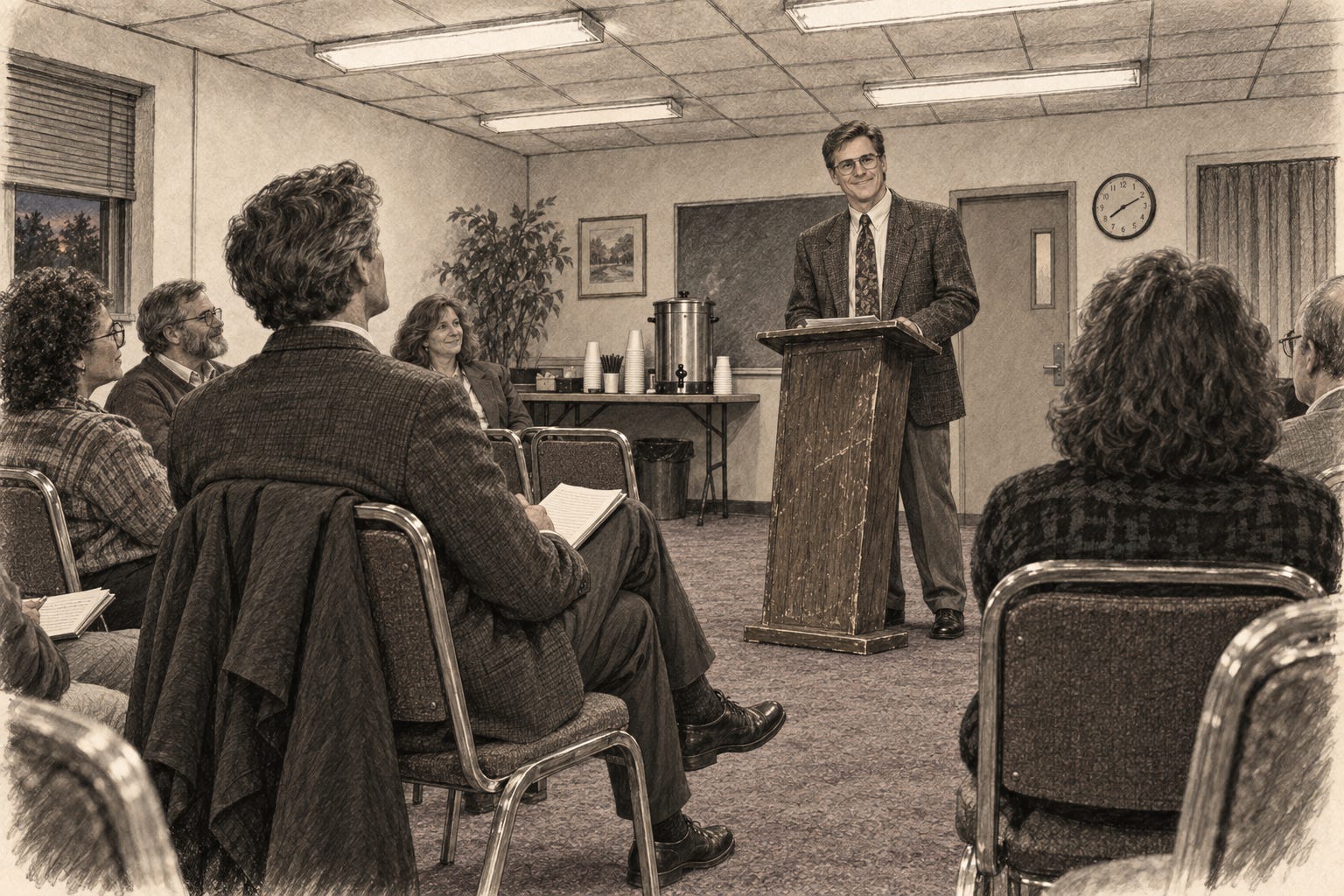
The answer arrived on a Tuesday night at Toastmasters, in a borrowed room that smelled like burnt coffee, with folding chairs and a wooden lectern that leaned a little to the left no matter how many times somebody straightened it. The speech had gone well, or so it seemed from behind the lectern. The notes stayed in order. Every planned point got made. The walk back to the chair had the quiet satisfaction of a job done cleanly.
Then the ah-counter stood up.
If you’ve never been to Toastmasters, the ah-counter is exactly what it sounds like: a member whose only job that night is to tally your filler words. Every um, every ah, every “you know” that leaks out while the brain catches up to the mouth. Ours was an older gentleman with a narrow notebook and a pen that had clearly spent thirty years in the same shirt pocket. Before reading his count, he did something that turned out to be the whole lesson. He asked the speaker to guess the number first.
The speech replayed in memory easily enough: a hesitation here, maybe a stray um while the next thought loaded. “Three,” came my answer. Confident. He looked down at his notebook.
“Forty-seven.”
That number rode home in the car and refused to get out of my head. Not because forty-seven filler words is embarrassing, since everybody at Toastmasters has a number like that in their past, but because not one of them had registered. This wasn’t off by a little. It was off by a factor of fifteen, about something done minutes earlier, out loud, in front of people. The speaker my memory recorded and the speaker that room actually heard were two different men, and only one of them had ever shown up in the mirror.
The question that followed was worse than the number itself. If self-perception could miss by that much on something so immediate and so public, what else was going unheard? People walk out of meetings certain they were clear. They end conversations convinced the point landed. Meanwhile everyone else in the room is quietly working around noise the speaker doesn’t know he’s making. The ah-counter just happens to write his tally down.
After that night, Toastmasters stopped being a club and became something closer to a lab. Recording the speeches was the easy part. Listening back was not, and it is not recommended as entertainment. The tape is merciless. It doesn’t preserve what a speaker meant; it preserves what he said. Where memory had filed away a smooth transition, the recording revealed rushing and a tightened voice. Where a pause could have landed with real weight, nervous sound had rushed in to fill the silence. Memory, it turns out, edits the footage constantly.
That discipline eventually led to the National Speakers Association and into rooms where the standard ran considerably higher than an ah-counter with a notebook. The early material wasn’t the inspirational kind: estate planning, public-fund investing, managing multibillion-dollar fixed-income portfolios. The audience was bankers, state treasurers, and government finance officers. Nobody in those seats leaned forward hoping to feel something. They leaned forward to check the math.
Rooms like that teach a specific lesson about communication. When the decisions on the table involve public money and the listeners are paid to be skeptical, no amount of energy rescues a weak argument. There is no theatrical move that saves a sentence that doesn’t hold. The language has to carry the entire weight of the idea, or the idea goes down with it.
Public Fund Investing for Dummies came out in 2007, and writing it became a masterclass in the hardest kind of communication: translating complexity without distorting it. The goal was never to make sophisticated ideas sound simple. It was to make them understandable while preserving their integrity, which is a much narrower target. Then the financial crisis arrived, interest rates fell off a cliff, and risks the book had been describing in the abstract became urgently real. Invitations multiplied. So did the teaching, eventually including work on professional accreditation programs across the country.
Those rooms taught the mechanics of explaining consequential ideas. But the rooms that taught the most about communication looked nothing like a conference hall. They were quieter, arranged in imperfect circles of metal folding chairs, coffee brewing in the corner, and a tension in the air heavier than anything financial risk produces. I have been clean and sober since November 16, 1989. In recovery meetings, there are no slides, no impressive introduction, no credential capable of carrying the story. There is only the truth of your experience, offered plainly: what my life was like, what happened, and what my life is like now.
The first part of that story contains wreckage. Broken trust, strained relationships, mornings that began with shame already in the room. And the turning point is rarely the triumphant moment people imagine. More often it begins with surrender, the admission that the life you are defending is destroying you and that your own thinking can no longer be trusted to lead you out. The last part of the story is not about perfection. It is about restoration, the slow return of dignity, trust, usefulness, and hope. People hear that progression and change the trajectory of their lives. Marriages get repaired. Families reunite. Men become present for children who had learned not to depend on them.
Not everyone finds the way out. Some of the funerals were overdoses. Some were suicides. Others simply disappeared, into prison systems or into lives narrowed almost beyond recognition. Stand in those rooms long enough and a conviction settles in: storytelling is not performance. It is stewardship. The way a story is told can open a door someone believed was permanently closed, or leave that door invisible.
That conviction eventually shaped the writing. It runs through Hijacked, a book born from watching how easily human judgment gets overtaken by fear, ego, addiction, resentment, technology, and distortions so subtle they barely register. Its companion journal, Unhijacked, grew from a related conviction: reclaiming clarity takes more than inspiration. It takes disciplined reflection, and the willingness to examine thoughts that feel unquestionably true.
Then, several years ago, came another level of rigor entirely. David JP Phillips was speaking about the science of storytelling in a famous TEDx talk, and what stood out was not his charisma but his insistence on measurement. In another TEDx talk, he described 110 observable elements of communication: voice, language, facial expression, body alignment, nervous energy, confidence, credibility, focus, presence. The framework appealed to the same instinct that once led to studying investment risk. If communication could be observed, it could be measured. If it could be measured, it could be improved.
Measurement, of course, also meant surrendering the flattering version of the speaker that existed only in his own mind. Some lessons apparently need to be learned more than once. The initial evaluation in Phillips’s year-long Presenter Mastery Program came back 39 out of 110. The score didn’t say incapable. It said, once again, that most of my communication was happening outside my own awareness. Forty-seven filler words had made the same point decades earlier. This was just the ah-counter with better instruments.
The improvement was unglamorous. Shoulder tension that showed up under pressure. Tonal shifts that undercut declarative statements. Facial expressions arriving a beat behind the meaning of the words. Movements that broadcast uncertainty even when the feeling inside was confidence. Dismantling habits built over decades offered no dramatic breakthrough, only observation, correction, practice, and another meeting with the gap between intention and impact.
The TEDx talk, now viewed more than 109,000 times, was the visible result. But the truer test came later, during a live keynote where nearly everything failed at once. The microphone cut out mid-sentence. The slides froze. The cameras faltered, and a murmur moved through the audience as the production unraveled. What held was not the technology. It was the preparation, and every broken moment was handled with a smile, some grace, and the composure that only comes from doing the work when no one was watching.

Years earlier, those disruptions would have taken the whole talk down with them. This time there was a pause, an adjustment, and the next sentence. The technology failed. The presence did not, and the room held. The final evaluation under the 110STEPS™ standard came back 79.5 out of 110, more than double where the journey began.
The diploma arrived recently, signed by David JP Phillips and his team. It matters, though not because another credential changes anything. It matters for what it represents: the willingness to put a deeply familiar part of oneself under honest measurement. Programs with real rigor do not flatter. They refine. They expose the habits self-image has learned to conceal, and they narrow the distance between how we believe we show up and how other people actually experience us.
For leaders, that distance is not a minor personal development issue. It compounds into organizational liability. A leader believes she has invited disagreement, while everyone in the room has quietly learned that disagreement carries a price. An executive is certain he communicates urgency; his team experiences volatility and starts managing him instead of the work. A company diagnoses itself with an execution problem when the real disease is fear, fragmentation, or trust that eroded so gradually nobody can name the day it left. Polished presentations and reassuring dashboards preserve the appearance of alignment long after the alignment itself has disappeared.
Organizations rarely fail for lack of intelligence. They falter because critical signals go unheard, uncomfortable evidence gets edited out, and blind spots enjoy the protection of authority. The higher a leader rises, the fewer people volunteer contradiction, and the easier it becomes to mistake that silence for agreement. Nobody stands up at the end of the quarterly review with a narrow notebook and a tally.
This is one of the central concerns of The Available Brain. Judgment is continuously shaped by forces that never announce themselves: distraction, stress, digital overstimulation, institutional habit, emotional residue, and the growing temptation to outsource difficult thinking altogether. We are accumulating cognitive debt while losing the very capacity required to notice it. Like those forty-seven filler words, the interruptions become so familiar they vanish from our own perception, even as everyone around us lives with their effects.
That Tuesday night still comes back: the burnt coffee, the fluorescent hum, the crooked lectern, and the certainty in the voice that said “Three.” The certainty is the part worth remembering. The greatest threat to our judgment is not always what we do not know. Sometimes it is what we are certain we already see clearly. The work of becoming a better speaker, writer, leader, or human being begins in the same place: learning to hear the forty-seven things we cannot yet hear.