


By Jim Koetting
My Taylor 814ce came back from a professional setup sounding better and playing worse. I thought I had a guitar problem, but what I eventually found was a problem of judgment—the same one that follows us into leadership, shapes how we interpret our lives, and becomes more dangerous when AI begins reinforcing what we already believe.
To someone who does not play guitar, 814ce is simply a model number. Guitarists know it as one of Taylor’s finest professional instruments, a model used by musicians such as Lindsey Buckingham; Zac Brown has also long been associated with Taylor guitars. I had played mine long enough to know how the neck should feel, how much pressure the strings should require, and how readily a chord should settle beneath my fingers.
The original nut and saddle—the small parts the strings rest on—had aged and worn over time. Replacing them restored a richness that had disappeared so gradually I had stopped noticing its absence. The tone was better, but the action, the distance between the strings and the fretboard, was higher than it had ever been. The guitar sounded more like itself, but felt less like itself in my hands.
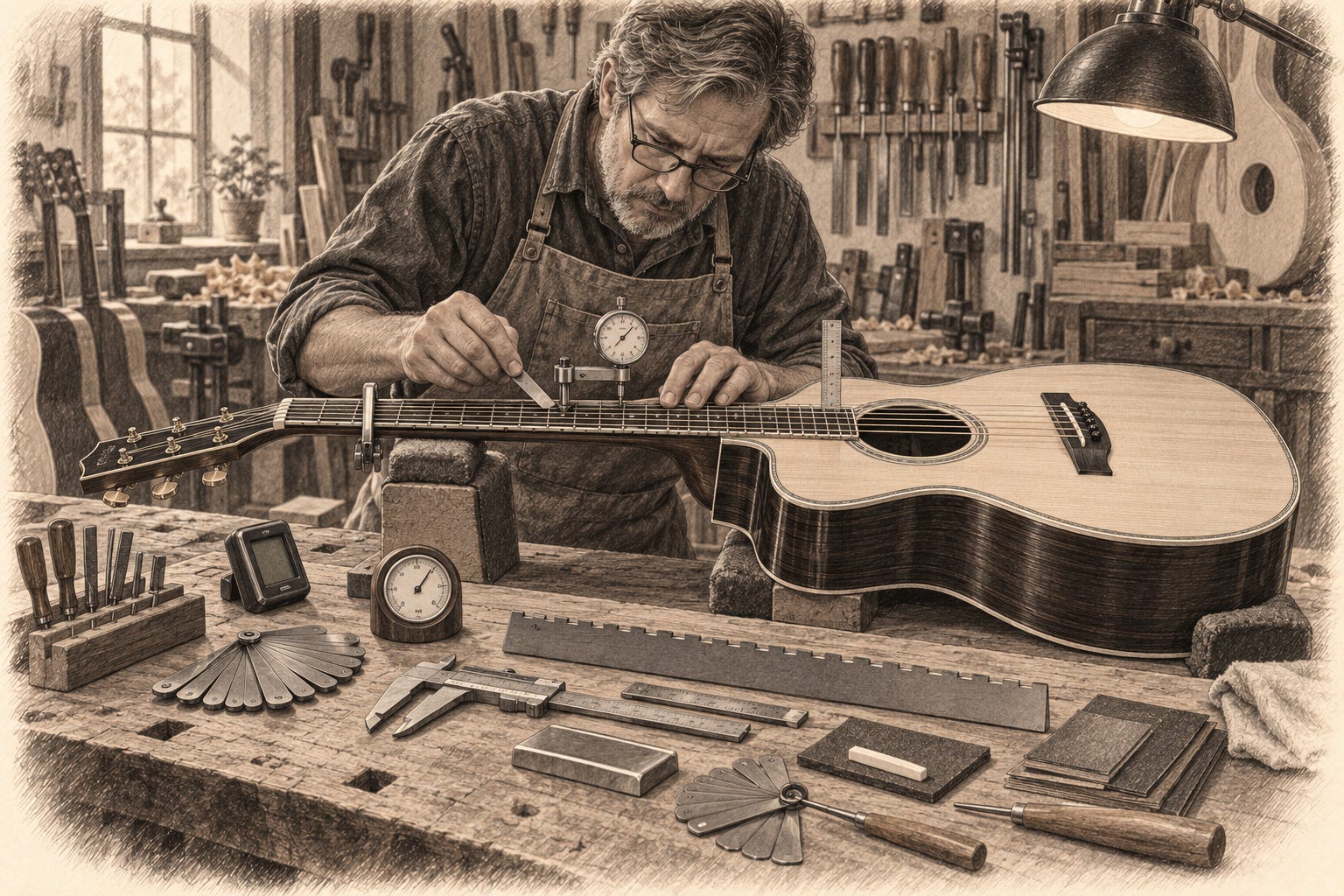
Installing better parts, I discovered, was not the same as completing the setup. The saddle still needed to be sanded to the proper height, and the neck, nut, and saddle needed to be evaluated together. Even the wood’s moisture content mattered because an acoustic guitar changes as humidity changes. Nothing was obviously broken, and the guitar could still be tuned and played. It simply had not been calibrated as a system.
Trying to understand what remained wrong led me to a video of an experienced guitar technician performing a complete setup. Before changing anything, he measured the neck’s curvature and the string height at several points. He adjusted the neck, retuned the guitar, and measured again because the first correction had already changed the conditions for the next. Years of experience had given him an intuitive feel for the instrument, but it had not made his gauges unnecessary.
No single perfect setup worked for every musician. One player may prefer low action and a light touch, while another strikes the strings hard enough to make that same setup buzz. Unless a technician understands the instrument’s original condition and the musician’s preferences, he can perform competent work and still return a guitar that is wrong for the person playing it. Without an outside reference, he may unknowingly calibrate the guitar against himself.
That was the larger idea hidden inside my frustration. Better parts had improved my guitar, but they had not calibrated it. The instrument could not step outside itself and determine whether it was right, and neither could the person working on it if his own preferences were the only standard.
Engineers use the word calibration with more precision than most of us do. Calibrating an instrument is not simply repairing it or making it perform better. It is to compare its readings with a reliable reference beyond itself. A laboratory scale cannot certify its own accuracy, and even the finest instrument eventually drifts. Because the drift is usually gradual, the instrument can continue reporting its measurements with complete confidence while becoming increasingly wrong.
Our minds can do the same thing. We spend decades refining what we know while giving far less attention to the instrument doing the interpreting. Family, culture, success, disappointment, ambition, fear, mentors, humiliation, and loss all help assemble the framework through which we understand the world. Eventually, those assumptions stop feeling like assumptions and begin to feel like reality.
This is not a defect found only in arrogant or oblivious people. It is part of being human. Much of our internal framework was built for good reasons. Some of it helped us survive difficult periods, succeed in demanding environments, or make sense of experiences we did not yet know how to carry. The danger begins when we forget that we are looking through a frame at all.
Success can make that drift especially difficult to see. A decision works, so we reuse the reasoning behind it. A leadership style produces results, so we trust it more deeply. An explanation goes unchallenged, so it hardens into fact. The longer our record of success, the easier it becomes to mistake our interpretation of reality for reality itself.
I have seen this happen in leaders, but I recognized it slowly because I first had to recognize it in myself. I have defended conclusions that made perfect sense within the boundaries of what I could see. I have mistaken experience for perspective and confidence for confirmation. I was not consciously rejecting the truth; I was interpreting everything through assumptions I no longer knew I was making.
Organizations make this harder because they can gradually remove the independent reference points their leaders need. Boards become passive, teams learn which disagreements are welcome, and colleagues begin editing themselves before they speak. No one has to demand agreement. People simply learn that some forms of candor carry a price, and silence slowly begins to resemble alignment.
A room in which everyone agrees may have reached a sound conclusion. It may also be a room in which the people who saw something different have stopped speaking or have already left. From the leader’s chair, those two rooms can look remarkably similar.
I learned the cost of trusting an uncalibrated mind long before I owned an expensive guitar. In 1989, I found myself sitting in a room with people who had years of sobriety while I had only days. I enjoyed drinking, and I did not want to hear that abstinence was the answer. I could listen to other people describe what alcohol had done to their lives and still explain why their experience did not apply to me. Their circumstances were different, their losses were different, and they were not the same as I was.
Someone in that room told me that my best thinking had brought me there. He suggested that, for a while, I might need to borrow my sponsor’s brain until I could trust my own again. I found the idea deeply uncomfortable because intelligence had always been one of the things I trusted most about myself. The suggestion that my mind could not reason its way out of the problem felt insulting.
Yet alcoholism contains a cruel contradiction: the mind required to recognize the illness is the same mind the illness has already altered. A person insisting that everything is under control may be describing his experience honestly. His perceptions simply no longer provide a reliable standard. Sincerity cannot make a distorted instrument accurate.
I have been completely clean and sober since November 16, 1989. Looking back, I understand that sponsors, meetings, accountability, and the experience of other recovering people formed a calibration system. They could see the drift I could not yet see from inside myself. Trusting an outside reading initially felt like humiliation, but it became an act of survival and, eventually, a path to freedom.
Ordinary blind spots are not addiction, and I do not want to stretch the comparison beyond what it can carry. Recovery simply gave me the clearest demonstration of a much wider truth: some conditions cannot be assessed accurately from inside the person experiencing them. In leadership, the consequences may unfold more slowly, but an intelligent and well-intentioned person can still carry an organization far from where everyone believes it is headed.
Human calibration is more complicated than measuring a guitar. No single flawless gauge exists for judgment. Data can be incomplete, advisers have biases, and an independent opinion is not automatically accurate. We need several reference points: measurable outcomes, the experiences of people affected by our decisions, colleagues who can disagree without calculating the cost, and trusted advisers who care enough to tell us the truth without making us smaller.
Artificial intelligence complicates this further. AI can challenge our assumptions, expose missing information, and introduce ideas we might never reach alone. It can also become the most sophisticated mirror ever built. We frame the question, choose the context, embrace the answers that feel right, and press back against those that disturb us. What returns may be our existing worldview rendered with greater fluency and authority.
Fluency is not independence. When output becomes unlimited, judgment becomes priceless, but judgment calibrated only against itself eventually becomes preference with a more impressive vocabulary. More information will not correct our drift if every new piece of information is interpreted through the same unquestioned frame.
The longer I work with leaders, the less convinced I become that their greatest need is more information. Most already possess more than they can absorb. What they often lack is an independent reading—something that can reveal the distance between their interpretation and what the people around them are experiencing.
An available brain is not one that never drifts. It is one that remains available to evidence, correction, disagreement, and the possibility that someone else can see what it cannot. The question is not whether we are intelligent enough to trust our judgment. It is when that judgment was last compared with anything beyond itself. If we cannot remember, our confidence may be telling us very little about whether we are still on course.